

How Bass Strings Are Made: Inside the Manufacturing Process
Learn how bass strings are made, from material selection and precision winding to quality control and packaging, with insights into OEM manufacturing.




Choosing the right acoustic bass strings involves more than comparing prices. For musical instrument brands, distributors, and wholesale buyers, core construction, wrap material, string gauge, surface treatment, and manufacturing consistency all matter when evaluating products for a specific market.
Different string specifications can support different product requirements, but no single material or construction is automatically best for every player or application. Buyers should evaluate the complete string design alongside instrument compatibility, target pricing, quality requirements, and supply capability.
This guide explains the key factors to consider when selecting acoustic bass strings, compares common construction options, and uses Alice® A616, A618, and A619 as examples of different product configurations.
For OEM brands, distributors, and wholesale buyers, the right product should match the target market and meet the required specifications. Before selecting a model or placing an order, evaluate the following factors.
Evaluation Factor | What Buyers Should Check |
Target market | Intended customer group, retail price range, and distribution channel |
Core construction | Core material and structure specified for the model |
Wrap material | Exact winding-material designation and available technical information |
String gauge | Individual string diameters, available sets, and instrument compatibility |
Surface treatment | Coating or finish specifications and any supported performance claims |
Quality requirements | Dimensional tolerances, production controls, inspection procedures, and applicable test data |
Product range | Availability of different constructions, materials, and specifications |
OEM/ODM capability | Branding, packaging, customization options, and project requirements |
Supply capability | Production capacity, lead times, quality consistency, and order requirements |
These factors should be considered together. A product that fits the target price may still be unsuitable if its specifications, packaging, or quality requirements do not match the intended market.
Acoustic bass strings generally consist of a core and an outer winding. Their complete construction, together with gauge and surface treatment, determines the specifications buyers need to evaluate.
Core construction and wrap material are separate considerations. Two models may use the same winding-material category but have different core structures. Conversely, two models with similar core structures may use different winding materials.
A high-carbon steel core is one construction option used in musical instrument strings. When evaluating a model, buyers should confirm its stated core material, structure, gauge, and other product specifications.
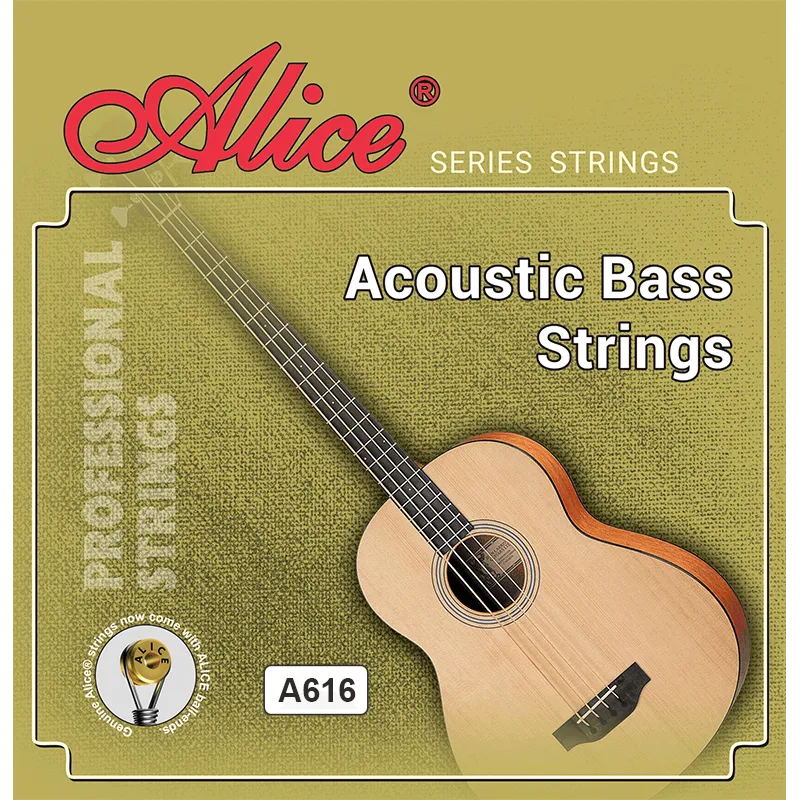
Alice® A616 acoustic bass strings use a High-Carbon Steel Core with Copper-Plated Alloy winding, according to the stated model specifications.
View the Alice® A616 Acoustic Bass Strings product page for model-specific details.
A hexagonal high-carbon steel core provides a different structural configuration from a conventional round core. However, the core shape alone does not establish that a string will have better tuning stability, greater projection, or superior tonal performance.
Alice® A618 and A619 use Hexagonal High-Carbon Steel Core construction, with different winding materials and surface treatments.
For a more focused comparison of the two Copper-Plated Alloy models, see A616 vs A618 Acoustic Bass Strings: Steel Core Differences Explained.
Copper-Plated Alloy is the winding-material designation used for Alice® A616 and A618 in the stated product information. Buyers should confirm the manufacturer's exact material specification rather than infer the full alloy composition or performance characteristics from the name alone.
When comparing Copper-Plated Alloy models, consider the core construction, gauge, surface treatment, price, and intended application as part of the complete product specification.
Phosphor Bronze is a copper-based alloy containing phosphorus and is commonly used in acoustic instrument strings. It is often associated with a warm tonal profile in acoustic-string product positioning, but the actual tonal result depends on the complete string construction and playing conditions.
Alice® A619 uses Phosphor Bronze winding with a Hexagonal High-Carbon Steel Core and Nano Polished Coating, according to the stated product specifications.
For a closer comparison of the two winding-material options, see Phosphor Bronze vs Copper-Plated Alloy Acoustic Bass Strings: Key Differences.
String gauge is another important selection factor because it relates to string tension and playing feel. However, the effect of gauge depends on factors such as scale length, tuning, material, and construction.
Rather than relying only on labels such as Light, Medium, or Heavy, buyers should compare actual product specifications.
Gauge Consideration | What Buyers Should Confirm |
Individual string diameter | The specified diameter of each string in the set |
Tension | Manufacturer-provided tension data, where available, under stated conditions |
Instrument compatibility | Recommended scale length and instrument requirements |
Playing requirements | Target users' preferences for tension and playing feel |
Product availability | Available gauges and set configurations for the intended market |
For brands developing their own ranges, gauge selection should be based on customer requirements and confirmed specifications. Buyers should not assume that gauge categories have identical diameter or tension definitions across different manufacturers.
For OEM and private-label projects, confirm whether the required gauge combinations are available and whether customization is supported.
Surface treatment is another specification to review when comparing acoustic bass strings. Buyers should identify the coating or finish used for each model and check what the manufacturer can substantiate about its intended function.
For example, Alice® A616 and A618 are listed with Anti-Rust Coating, while A619 is listed with Nano Polished Coating, according to the stated product information.
When evaluating coatings, buyers should consider:
The official coating or surface-treatment designation.
Whether technical documentation describes its intended function.
Whether relevant corrosion-resistance or durability test data are available.
Whether claims about playing feel, service life, or tone retention are supported by suitable evidence.
Whether the coating specification is consistent across the models being compared.
A coating name alone does not establish a specific service life or performance advantage. If corrosion resistance or long-term durability is an important selling point, request the relevant product information or test results before making a claim.
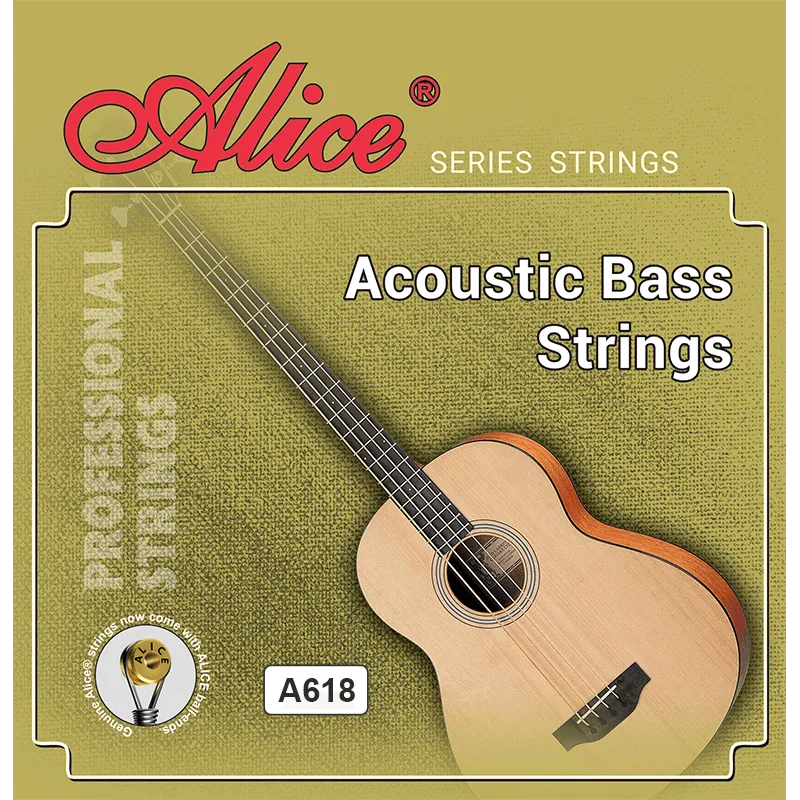
The most suitable string configuration depends on the intended users, required specifications, target price, and application. Instead of assigning a fixed quality level to each material, buyers should define the product requirements first and then compare available models.
Products intended for practice and regular performance should be evaluated against the needs of the target users and the intended retail price.
Buyers should check:
The complete string specification.
Available gauges and instrument compatibility.
The stated surface treatment.
Quality-control requirements.
Price and packaging requirements for the target market.
Alice® A616 and A618 are listed for Practice & Performing applications. Their different core structures provide buyers with distinct model specifications to compare.
Explore A616 and A618 for their respective product details.
For products intended for concert or performance-oriented markets, brands may need to evaluate tonal characteristics, playing feel, instrument compatibility, and other requirements that matter to their target customers.
These requirements should be verified through product specifications and, where necessary, sample testing rather than inferred from a material name alone.
Alice® A619 is listed for Concert applications and combines Phosphor Bronze winding, a Hexagonal High-Carbon Steel Core, and Nano Polished Coating.
View the Alice® A619 Acoustic Bass Strings product page for its stated construction and specifications.
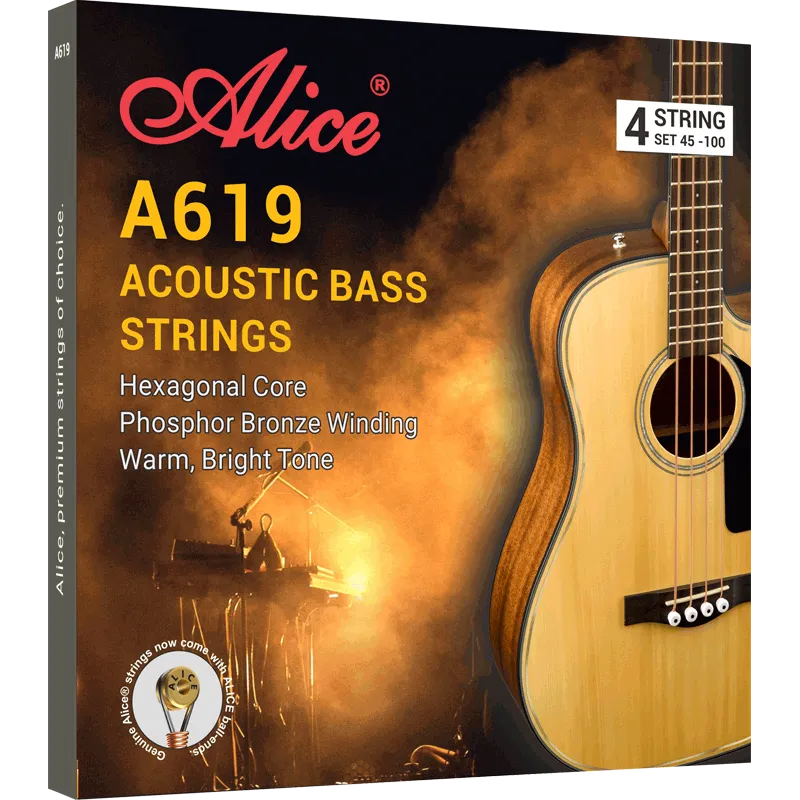
Alice® offers acoustic bass string models with different combinations of core construction, winding material, and surface treatment. The following table summarizes the stated specifications.
Model | Application | Core | Wrap Material | Surface Treatment |
Practice & Performing | High-Carbon Steel | Copper-Plated Alloy | Anti-Rust Coating | |
Practice & Performing | Hexagonal High-Carbon Steel | Copper-Plated Alloy | Anti-Rust Coating | |
Concert | Hexagonal High-Carbon Steel | Phosphor Bronze | Nano Polished Coating |
Note: Confirm all specifications and application labels against the current official product information before publication.
The comparison shows how different construction and material combinations can be represented within a product range. A616 and A618 share the same stated winding-material category but differ in core structure. A619 uses Phosphor Bronze winding and a different stated surface treatment.
Buyers can review these individual models or browse the full Alice® Acoustic Bass Strings range to compare available options.
For brands and distributors, supplier evaluation should extend beyond an individual product. A suitable manufacturing partner should be able to explain product specifications, quality requirements, production arrangements, and the scope of available OEM/ODM services.
Check whether the supplier can provide the required combinations of core construction, winding material, gauge, and surface treatment. Confirm which configurations are standard products and which, if any, require customization.
Ask how the supplier manages relevant production and inspection processes. Depending on the product and manufacturing system, buyers may wish to review:
Wire diameter and dimensional controls.
Core and winding specifications.
Winding-process controls.
Surface-treatment procedures.
Finished-product inspection and acceptance criteria.
Batch identification and handling of nonconforming products.
Where consistency is a critical purchasing requirement, discuss the applicable tolerances, inspection records, and quality documentation before placing an order.
For wholesale and OEM projects, confirm production lead times, order requirements, packaging arrangements, and the supplier's ability to support expected demand.
Production scale or automation figures can provide context, but they should not replace specific discussions about product quality, capacity allocation, delivery schedules, and quality-control requirements.
Before starting a project, clarify:
Product specifications and required samples.
Brand labeling and packaging.
Applicable order quantities and lead times.
Quality acceptance criteria.
Documentation requirements.
Which product or packaging customizations are available.
Clear specifications and acceptance criteria help both parties evaluate the project before production begins.
According to the company information provided for this article, Guangzhou Romance Musical Instrument Co., Ltd. was established in 1999 and integrates research and development, manufacturing, and sales.
The stated manufacturing facilities include:
An approximately 30,000 m² production base.
12 musical instrument string production lines.
16 string-material processing lines.
A 5,000 m² warehouse center.
More than 1,000 production machines.
More than 90% automated production equipment.
These figures should be confirmed against current company records before publication.
The company information also describes material and finished-product testing using chemical, mechanical, and structural methods. Buyers with specific quality requirements should confirm the applicable test procedures, inspection criteria, and available documentation for their intended products.
If ISO 9001:2015 is mentioned in the final published version, verify the current certification status and scope. Use “ISO 9001:2015 certified” only if a valid certificate supports that claim; otherwise, use wording that accurately describes the company's quality-management practices.
For more information about the product range, visit Alice® Acoustic Bass Strings.

Choosing acoustic bass strings requires a balanced assessment of construction, materials, gauge, surface treatment, application, and commercial requirements.
For brands and distributors, the most effective selection process starts with a clear definition of the target market, followed by a comparison of complete product specifications and sample evaluation where needed. Supplier quality controls, production capability, and OEM/ODM arrangements should also be assessed before a purchasing decision is made.
By comparing these factors systematically, buyers can select products that better match their requirements and build a more coherent acoustic bass string portfolio.
Alice® offers acoustic bass string models with different stated core structures, winding materials, and surface treatments. For OEM/ODM projects, buyers can discuss their target market, required specifications, packaging, and project requirements with the team.
Explore the A616, A618, and A619 models, or browse the full Acoustic Bass Strings range.
Contact Alice® to discuss your acoustic bass string product requirements.
Buyers should compare core construction, winding material, string gauge, instrument compatibility, surface treatment, price, quality requirements, and supplier capability. The relative importance of each factor depends on the intended market and application.
Core structure is one part of the complete string design, but it does not determine performance on its own. Gauge, winding material, construction, surface treatment, instrument setup, and playing conditions also matter.
Confirm individual string diameters, available set configurations, scale-length requirements, and any manufacturer-provided tension information. Do not assume that gauge labels or tension characteristics are identical across manufacturers.
Confirm the official coating specification, its intended function, and any supporting technical documentation. Claims about corrosion resistance, service life, or tone retention should be supported by appropriate evidence.
Evaluate product-range capability, specification support, quality-control processes, production capacity, lead times, packaging options, and the availability of required OEM/ODM services. Confirm project-specific requirements before production begins.