
The Complete Guitar Capo Guide: Types, Uses, and How to Choose One
Learn how guitar capos work, compare capo types, check guitar compatibility, avoid common problems, and choose the right capo for your needs.




For acoustic bass string brands, distributors, and wholesale buyers, wrap material is an important factor in product selection and product-line planning. Different material options can help brands differentiate their offerings, but material alone does not determine a string's complete tonal characteristics, durability, or playing performance.
Phosphor Bronze and Copper-Plated Alloy are two wrap-material options used in acoustic bass string products. Understanding their differences, along with core construction, gauge, and surface treatment, helps buyers evaluate products more accurately and develop ranges for different market requirements.
Alice® offers acoustic bass string models with different material and construction combinations, including A616, A618, and A619. This guide compares the two wrap materials, explains other factors that influence string performance, and outlines how brands can use these options when planning an acoustic bass string product line.
An acoustic bass string typically combines a core with an outer winding. The core and winding work together to form the string's construction, while surface treatments may provide additional product characteristics.
The winding material is one consideration when evaluating acoustic bass strings, but it should not be considered in isolation. Core structure, string gauge, winding construction, surface treatment, instrument compatibility, and manufacturing specifications also influence the final product.
Phosphor Bronze is a copper-based alloy commonly used in acoustic instrument strings. It is often associated with a warm tonal profile in acoustic-string product positioning.
Copper-Plated Alloy is a material designation used for certain string winding constructions. Its precise composition and performance characteristics should be evaluated against the manufacturer's product specifications rather than inferred from the name alone.
For buyers, the practical question is not simply which material is better. It is which complete string specification best fits the intended application, target price, and customer requirements.
The following table summarizes the main considerations when comparing these two wrap-material options.
Comparison Factor | Copper-Plated Alloy | Phosphor Bronze |
Material consideration | Confirm the exact alloy and plating specification with the manufacturer | Copper-based alloy containing phosphorus |
Tonal positioning | Depends on the complete string construction and product specification | Commonly associated with a warm tonal profile in acoustic-string positioning |
Other performance factors | Core, gauge, winding construction, and surface treatment remain important | Core, gauge, winding construction, and surface treatment remain important |
Product-line role | Can be considered for general-purpose product ranges | Can be considered when developing an alternative material option |
Selection criteria | Target price, required specifications, application, and customer expectations | Target price, required specifications, application, and customer expectations |
Neither material should automatically be treated as superior. A meaningful comparison requires complete product specifications and, where tonal or durability differences are important, suitable product testing.
Copper-Plated Alloy is one option for brands developing acoustic bass strings for general-purpose markets. Whether a particular model is suitable for beginners, educational use, regular practice, or performance depends on its complete specifications and intended positioning.
When evaluating a Copper-Plated Alloy model, buyers should consider:
Core construction: Check the specified core material and structure.
String gauge: Confirm the available gauges and their suitability for the target instrument and players.
Surface treatment: Verify the stated coating or finish and any supported performance claims.
Product positioning: Match the complete specification and cost requirements with the intended market.
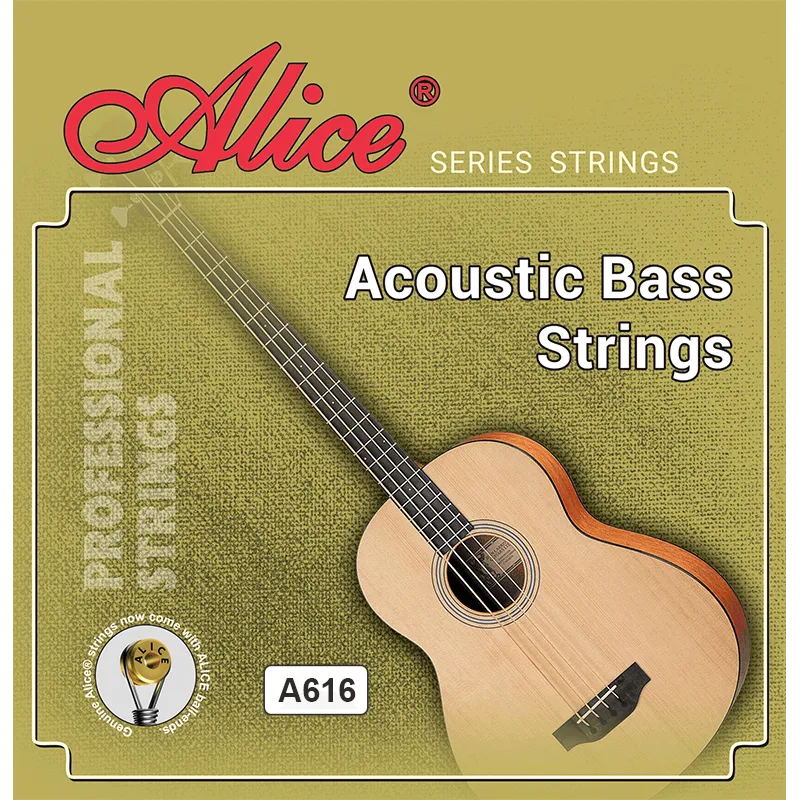
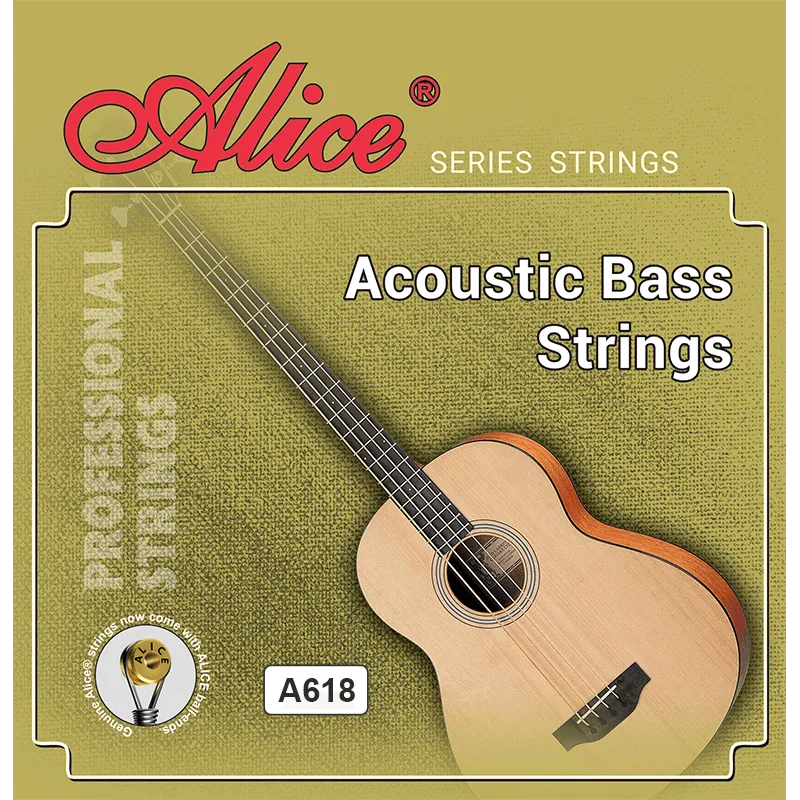
Alice® A616 and A618 are two examples of acoustic bass strings using Copper-Plated Alloy winding, according to their stated product specifications. Their core structures distinguish the two models:
Alice® A616 Acoustic Bass Strings: High-Carbon Steel Core.
Alice® A618 Acoustic Bass Strings: Hexagonal High-Carbon Steel Core.
These models provide a useful example of how different core structures can be offered alongside the same stated winding-material category. Buyers should compare their complete specifications before deciding which model is more suitable for a particular product range.
Phosphor Bronze is commonly used in acoustic instrument strings and is often selected when a brand wants to offer a different material option with a recognizable acoustic-string positioning.
However, Phosphor Bronze alone does not guarantee a specific tonal result or a particular level of performance. The finished string's characteristics depend on the interaction of the winding material with the core, gauge, construction, and surface treatment.
When evaluating Phosphor Bronze acoustic bass strings, buyers should consider:
The exact winding-material specification.
Core material and structure.
Available gauges and instrument compatibility.
Surface treatment and the performance claims supported by product information or testing.
The intended retail price, customer segment, and application.
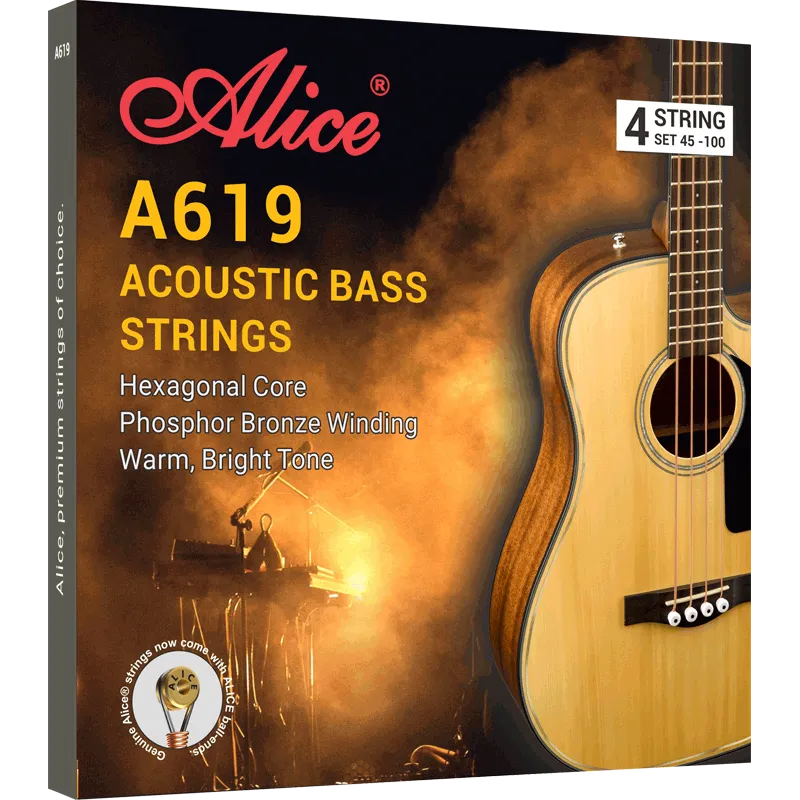
Alice® A619 is a Phosphor Bronze acoustic bass string model. Its stated product construction combines Phosphor Bronze winding with a Hexagonal High-Carbon Steel Core and Nano Polished Coating.
View the Alice® A619 Acoustic Bass Strings product page for model-specific details.
For brands considering a new material option, A619 can serve as a reference point for evaluating a different combination of winding material, core construction, and surface treatment.
Wrap material is only one part of an acoustic bass string's construction. Before comparing products, buyers should review the complete specification.
The core is a fundamental component of the string. Its material and structure form part of the overall design.
For example, Alice® A616 uses a High-Carbon Steel Core, while A618 and A619 are specified with Hexagonal High-Carbon Steel Cores. This structural difference helps distinguish the models, but it does not by itself establish that one will deliver better tone, durability, or stability.
Gauge affects string tension and playing feel, so buyers should confirm available gauges and compatibility with the intended instrument.
When developing a product range, compare the actual diameter of each string, the recommended scale or instrument compatibility, and the target player's requirements. Do not assume that models with different winding materials share identical gauges or specifications.
Surface treatments are another product specification to evaluate. Alice® A616 and A618 are listed with Anti-Rust Coating, while A619 is listed with Nano Polished Coating, according to the stated model information.
These coating names should be distinguished from proven performance outcomes. Claims about corrosion resistance, service life, or tone retention should be supported by applicable product data or testing.
The final product reflects the combination of core structure, winding material, gauge, winding construction, surface treatment, and manufacturing controls.
For this reason, brands and distributors should compare complete product specifications rather than selecting strings solely by the name of the winding material.
For brands and distributors, material selection should begin with the target market and product requirements rather than an assumption that one material is always better.
Identify the intended customer group, retail price, and distribution channel. A product designed for broad retail distribution may have different commercial requirements from one developed for a specialized instrument range.
Material choice should be considered alongside the complete product specification and cost structure.
Before choosing a model, confirm:
Core material and construction.
Winding material and construction.
Available gauges and instrument compatibility.
Surface treatment and supported performance claims.
Packaging, labeling, and other project requirements.
This comparison helps buyers evaluate the actual differences between models and avoid making decisions based on material names alone.
When tone, playing feel, or durability is a key selling point, request samples and assess them under relevant playing conditions. Where necessary, establish consistent comparison criteria and document the test conditions.
Testing is particularly useful when a brand intends to make specific product claims or differentiate a new model from an existing range.
Phosphor Bronze and Copper-Plated Alloy can be considered as different options within a broader product portfolio. Their roles should be determined by the complete specifications, target customers, price points, and product-testing results.
A portfolio can include multiple models for different requirements without assuming that each material must correspond to a fixed entry-level, intermediate, or professional tier.
Alice® offers acoustic bass string models with different stated combinations of core construction, winding material, and surface treatment.
Model | Core | Wrap Material | Surface Treatment | Stated Application |
High-Carbon Steel | Copper-Plated Alloy | Anti-Rust Coating | Practice & Performing | |
Hexagonal High-Carbon Steel | Copper-Plated Alloy | Anti-Rust Coating | Practice & Performing | |
Hexagonal High-Carbon Steel | Phosphor Bronze | Nano Polished Coating | Concert |
Note: Model specifications and application labels should be confirmed against the current official product information before publication.
The comparison illustrates how a product range can offer different construction and material combinations. A616 and A618 share the same stated winding-material category but differ in core structure, while A619 uses Phosphor Bronze winding and a different stated surface treatment.
For model-specific information, buyers can visit the individual product pages or browse the complete Alice® Acoustic Bass Strings range.
For musical instrument brands, distributors, and wholesale buyers, a well-planned product range should reflect actual customer needs rather than relying on material labels alone.
Consider the following steps:
Define market requirements. Identify the target customers, retail price range, distribution channels, and expected applications.
Set product specifications. Determine the required core construction, winding material, gauges, surface treatment, and instrument compatibility.
Compare available models. Review manufacturer specifications and identify the differences that matter to the intended market.
Evaluate samples. Assess playing feel, tonal characteristics, and other relevant attributes under consistent conditions.
Confirm commercial requirements. Discuss packaging, labeling, order quantities, and any available customization options with the supplier.
This process gives brands a clearer basis for developing a product portfolio and explaining the differences between models to distributors and end customers.
Choosing an acoustic bass string material is one step in developing a product that fits your market. Core construction, gauge, surface treatment, target price, and customer requirements should also be considered.
Explore the Alice® A616, A618, and A619 acoustic bass strings to compare their stated constructions and material combinations.
For OEM/ODM projects, contact Alice® to discuss your target market, required specifications, and product-line needs.
They are different winding-material options. Phosphor Bronze is a copper-based alloy containing phosphorus, while the exact composition and construction of a Copper-Plated Alloy string should be confirmed with the manufacturer. The finished string's characteristics also depend on its core, gauge, construction, and surface treatment.
No. Wrap material is one factor, but core construction, gauge, winding design, surface treatment, the instrument, and playing conditions can also affect the result. Specific tonal differences are best evaluated through product samples or reliable testing.
Compare the core, winding material, gauge, instrument compatibility, surface treatment, price, and intended application. Confirm the actual product specifications rather than inferring performance from material names alone.
According to their stated specifications, A616 uses a High-Carbon Steel Core with Copper-Plated Alloy winding; A618 uses a Hexagonal High-Carbon Steel Core with Copper-Plated Alloy winding; and A619 uses a Hexagonal High-Carbon Steel Core with Phosphor Bronze winding. Their listed surface treatments and application labels also differ. Check the official product pages for the current specifications.
For OEM/ODM requirements, buyers should contact Alice® to confirm available product configurations, specifications, packaging options, and project requirements. Availability and customization scope should be confirmed for each project.